Editorial Team
Publication Date
October 8, 2025
Sunita Neupane, GPJ Nepal
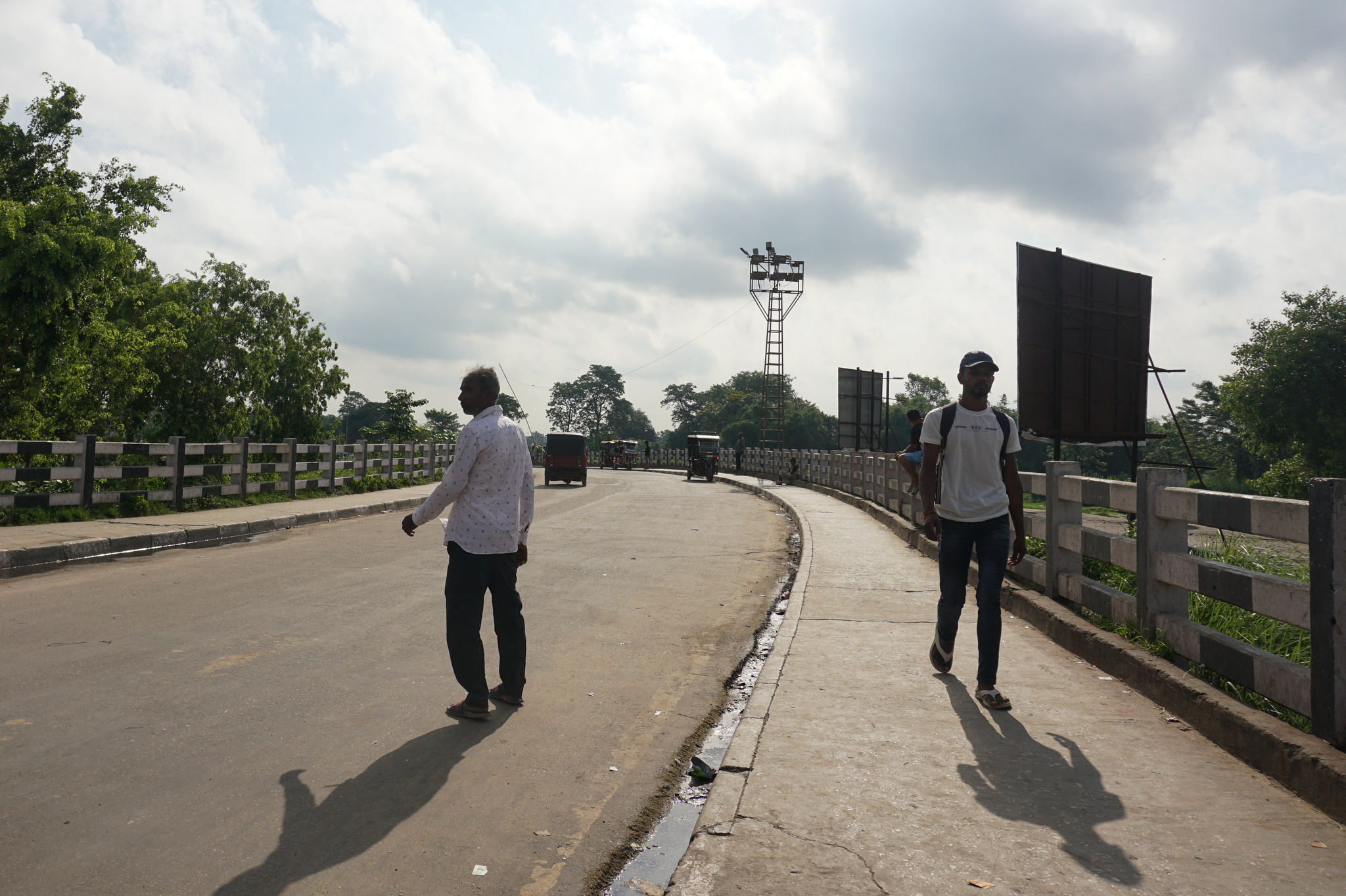
The Birgunj-Raxaul border between Nepal and India. Human rights groups say traffickers take advantage of this open crossing to transport Nepali girls and women, often lured through social media, into forced sex work across the border.
NUWAKAT DISTRICT, NEPAL — Tamang’s parents tried for years to coax vegetables out of dry, barren land. They cared for a small herd of cattle, and ploughed their neighbor’s fields when times were especially tough.
As she watched her parents struggle, Tamang dreamed of a different future. She wanted to become a nurse and ease her parents’ burden. By the time she was in sixth grade, she walked a two-hour round trip to school every day in an attempt to achieve that dream.
Then, when she was just 13 years old, what she thought was hope appeared. Someone on Facebook told her that she could get a job if she left home with him. Her parents agreed that she could go.
The man from Facebook never told her what kind of job she’d have. But once she traveled deeper into India to a city called Shantipur, she found out: She was to be a sex worker, serving more than a dozen clients every day.
She decided that this was her fate — the only way, she believed, that she could lift her family from its extreme poverty. (Global Press Journal is only publishing Tamang’s family name because of the stigma associated with her experience.)
As access to social media has grown in rural Asia, so has human trafficking, according to data from think tanks, law enforcement and nonprofits that try to stem the flow of people, often young children, into the hands of criminals who abuse them.
Nepal was late to adopt social media. In the early 2010s, less than 10% of the country’s population had internet access. But by the beginning of 2025, 55% of the population had some form of connectivity. There are about 39 million mobile phone connections — that’s about 132% of the total population, including many people who have more than one cellphone.
That meant that traffickers could expand their efforts to remote villages, where extreme poverty is common. Paired with low education levels, girls from these areas are at high risk of being lured into sex slavery. They’re targeted through lengthy online grooming conversations before being enticed to India.
About 41% of women who are trafficked say they were promised marriage during the grooming process, which young women and girls see as an opportunity for financial security and a higher social status.
Taylor Robb-McCord, a spokesperson for Meta, which owns Facebook, says that “human exploitation is abhorrent and not allowed on our platforms,” adding that Meta prohibits and removes content that enables human exploitation, including trafficking and smuggling. Meta’s policies are created in collaboration with organizations, including the United Nations, that have expertise in issues related to human trafficking.
“Fighting human exploitation is everyone’s responsibility, and because we serve billions of people across different cultures and perspectives, we make it a priority to reduce harm on our platforms,” Robb-McCord says.
Trafficking hot spot
During the coronavirus lockdown, cases of social media-based trafficking increased, as criminals took advantage of the anxiety and economic hardship caused by the closure of schools and workplaces, says Narendra Kunwar, spokesperson for the government’s Anti-Human Trafficking Bureau.
In 2022, South and Central Asia reported the highest incidence in the world of trafficking of women and children, with nearly 50 million people being trafficked in and from the region, according to the report “Human Trafficking in Asia: A Hidden Scourge,” by GROW, a think tank.
In its 2024 “Trafficking in Persons” report, the United States Department of State found that India and Nepal are major destinations for people forced into sex work, who are often from South Asian countries, including Nepal, Bangladesh, Bhutan and Pakistan. An estimated 1.5 million Nepalis are at risk of being trafficked, according to the report.
Poverty drives many Nepali women into the hands of traffickers who exploit their hopes for a better life, says Charimaya Tamang, who heads the Shakti Group, a Nepali nonprofit run by people who had been trafficked. Charimaya Tamang (who is not related to Tamang, the girl highlighted in this article) was rescued in 1996, along with 500 other Nepali, Indian and Bangladeshi women, who were freed by the Indian government during a raid on Mumbai brothels.
“In the past, brokers would go door to door to lure women into prostitution and sell them to brothels in India,” Charimaya Tamang says. “But today, they have weaponized the internet, using social media platforms to identify and lure women and girls, then supply them to flats across India.”
Bishwo Ram Khadka, executive director of Maiti Nepal, a nonprofit focused on helping exploited women and children, says traffickers lure girls online with promises of jobs or marriage, then take advantage of Nepal’s open border with India to move them quickly.
Tamang’s older sister, who disappeared more than two years ago, also is thought to have been sold into sex slavery in India, Khadka says. There are ongoing efforts to find and rescue her.
The promises that traffickers make online to young girls are so attractive that Tamang fell into the same trap.
‘Why are you doing this?’
Tamang, whom Global Press Journal interviewed at a safe house for former sex workers, was recruited through Facebook by a man who promised that she would make money if she traveled with him. Together, they crossed the open border between Nepal and India in a minivan, then headed by rickshaw and train to reach the city of Sonagachi, known for its enormous red light district. From there, it took another hour to reach Shantipur, a city of about a quarter of a million people. Tamang says she was captivated by the tall buildings and vibrant streets.
But once she was introduced to her male employer, she says the man she traveled with left and never returned. She says she still searches for him on Facebook but can’t find him.
Tamang says she rested for two days at the apartment in Shantipur, then was forced to begin work. Her employer registered her on an Aadhaar card, the identity card issued by the Indian government, as 22 years old — nine years older than she was.
In the past, brothel owners used printed photo albums to showcase women and girls, says Ramsharan Poudel, deputy director of Aafanta Nepal, an anti-human trafficking nonprofit in Nepal.
Social media has sped up that side of the problem as well. Tamang’s employer posted pictures of Tamang and other girls on WhatsApp, so clients could choose them.
Tamang says she earned 500 Indian rupees (about US$5.70) per client. Of that, she says, she turned over 150 Indian rupees (US$1.71) to her employer. A man tracked the arrival and departure of each of her clients; she was forbidden to spend more than 20 minutes with each one.
Some policemen and army personnel came as clients, she says, and asked what she was doing there.
“Why are you doing this at such a young age?” they asked. “Go home.”
Growing up, Tamang saw her aunts and sisters return from India wearing beautiful clothes and gold jewelry. She wanted the same, but didn’t know then that those aunts and sisters, too, were trafficked. For them, the pull to earn money was so strong that they returned to brothels in India, even after visiting home.
Tamang, too, bought beautiful clothes for herself. But those shopping breaks were short; she says she served customers from 11 a.m. to 3 a.m. every day.
A complex, monumental problem
Prosecuting human traffickers is exceptionally challenging because of the cross-border nature of the problem, says Kunwar, from the Anti-Human Trafficking Bureau. Once people move into India, he says, it’s outside the jurisdiction of the Nepali police.
“Conducting investigations is significantly more complex,” he says.
The bureau reported that 434 women and girls have been forced into sex and other work in India since 2019. During this period, Nepali law enforcement arrested 530 of the 944 people charged with trafficking-related crimes. Most were later convicted and served time in prison. The maximum sentence is 20 years.
That’s a drop in the bucket. According to Nepali police data, 36,912 children went missing between 2013 and 2024 (11,299 boys and 25,613 girls, all under the age of 18). Most of the girls are thought to have been trafficked into India.
The onus is on the accuser to present evidence that they were trafficked, says Charimaya Tamang, of the Shakti Group. They’re asked to provide detailed histories, but their memories might be blurred due to psychological distress, she says.
The Nepal government aligns its laws with international protocols, notably ratifying the Palermo Protocol in June 2020, which provides a universally recognized definition of trafficking and calls for extensive support for those who get out.
But Nepal hasn’t enacted specific legislation to address international protocols, says Rabindra Sapkota, from Aafanta Nepal. Sometimes women and girls forced into sex work decline to testify against the perpetrators, fearing reprisals or because they are being paid to stay silent.
A new life
When it became clear that Tamang was likely trafficked, Maiti Nepal added her name to a list of children who needed rescue. Through its investigative efforts in India’s red light districts, it identified the apartment where she and other girls were being held. In February 2024, Maiti Nepal, with help from the Indian police, the Nepali consulate and child rescue organizations, raided the apartment. They found nine girls, including Tamang, who was hiding under a bed. All the girls had Aadhaar cards that claimed they were adults and had come to the brothel voluntarily.
When the police released the girls, they returned to the brothel. Someone from Maiti Nepal went to Tamang’s village and got her birth certificate and school documents, which proved to Indian police that she was, by then, 15 years old. They went back to the apartment, but found that Tamang had been moved to another location.
Earlier this year, Maiti Nepal located Tamang once again, this time in an apartment in Kolkata. By the time the team arrived, many of the girls had fled. Tamang hid behind a door, and the police found her.
They took her to a child protection home in India, then turned her over to Maiti Nepal, which brought her to Kathmandu.
Tamang wants to return to her village, to walk the paths that were familiar to her in her childhood, to sit in a classroom where dreams are born, to share laughter with friends under an open sky.
Sunita Neupane is a Reporter-in-Residence based in Kathmandu, Nepal. Prior to joining Global Press Journal, Sunita worked with leading Nepali media outlets including Naya Patrika, Ratopati.com, and Annapurna Post Daily. She holds a Bachelor of Law degree from Nepal Law Campus and brings a legal perspective to her journalism, which focuses on social issues and human rights. Her reporting explores topics such as gender-based violence, LGBTQ+ rights, caste discrimination, and public health challenges.