
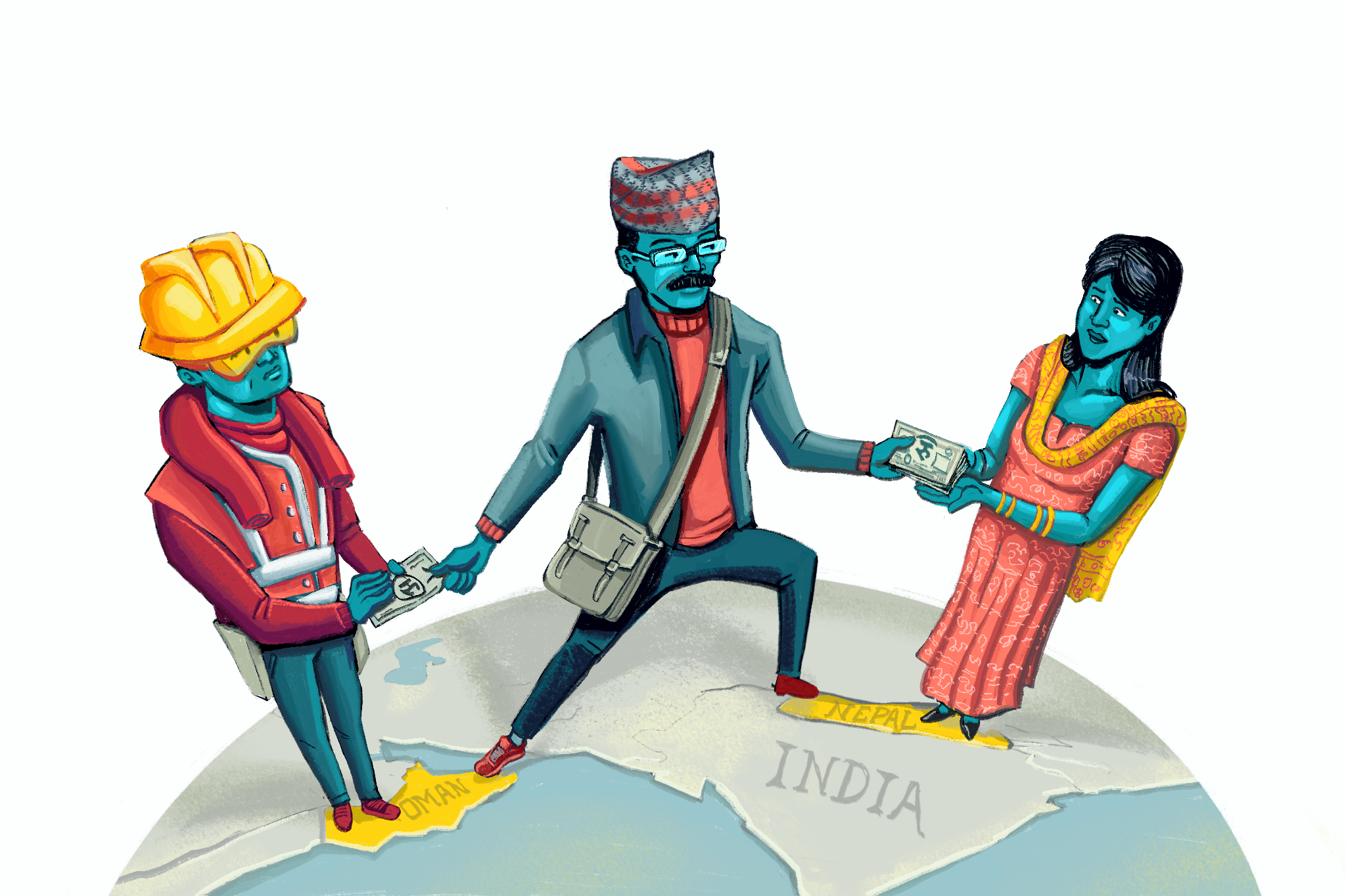
Illustration by Matt Haney, GPJ
KATHMANDU, NEPAL — A centuries-old practice of moving money is in the crosshairs of government officials, who say it’s a hotbed for financial crimes.
It’s called the hundi system. This local form of banking, separate from formal financial institutions, relies on middlemen called hundis, who traditionally carried cash from one person to another, no matter how far.
Today, hundis provide an illegal but crucial service for many of the 3.5 million Nepalis who work abroad and need to send remittances home. The hundis collect money in person, transfer it to digital wallets — sometimes illegitimate ones — then invest it, sometimes in cryptocurrency, which is illegal in Nepal, or illicit activities like gold smuggling or drug trafficking. They still deliver money to families, who, instead of paying bank fees, earn interest (typically 5% to 7%) and don’t have to travel to bank branches to collect the money — a significant benefit for families in remote regions. These families often rely on subsistence farming or day labor to survive. Every rupee makes a difference.
It’s a black market that the government has long tolerated. Now, government officials aim to dismantle it entirely. Fresh scrutiny began in April, when police arrested 21 people, charging them with a host of financial crimes connected to illegitimate digital wallets, which they say were used to disguise fraudulent activity as remittances.
“These informal operators turn black money into white by paying families of migrant workers with cash sourced from illegal activities like gold smuggling or cryptocurrency,” Central Investigation Bureau spokesman Yubaraj Khadka says. “It is a criminal offense against foreign exchange regulations.”
The hundi system weakens Nepal’s foreign currency reserves, says economist Chandra Mani Adhikari. Still, he acknowledges that it’s more practical than banks for many Nepalis, especially in remote regions.
“Until workers can easily send money home through formal channels, the hundi system will thrive,” Adhikari says.
A global system
Nepal’s hundi system went global when hundreds of thousands of Nepalis began working abroad in the 1980s. Now, their remittances sent via formal channels amount to more than a quarter of the country’s gross domestic product. That’s not counting illegal hundi transfers.
Legal remittances increased by 16.5% between July 2023 and July 2024, to 1.4 trillion Nepali rupees (about US$10.5 billion). But about 40% of Nepal’s economy is based on informal transactions, according to the Central Department of Economics at Tribhuvan University.
The system grew exponentially after Nepal Rastra Bank, Nepal’s central bank, instituted the Integrated Circular for Payment Systems in 2023, which banned remittance transfers within Nepal.
In February, the Financial Action Task Force added Nepal to its grey list for the first time since 2014 — marking the country as high-risk while lowering its global economic standing and ability to obtain credit and attract foreign investment. In the decision, the global watchdog and anti-money laundering organization cited Nepal’s overreliance on hundis.
To get off the grey list, Nepal must make tangible progress on seven key reforms — including cracking down on major hundi operators. Crucially, however, the FATF specifies that the reforms must not hinder financial inclusion — an important characteristic of the hundi system.
Less than two months after the FATF added Nepal to the grey list, police cracked down on a hundi operation and arrested 21 people.
‘We know it is illegal’
Bindeshwar Das has worked in Qatar for 20 years. Every four months, he turns over 4,500 Qatari riyals (about US$1,230) — plus a fee of 37 riyals (about US$10) — to a hundi there. The hundi works with partners in Nepal to quickly deliver cash to Das’ wife in rural southeastern Nepal. It’s of no consequence to Das what happens to the money after it leaves his hands. As long as the right amount gets to his wife, he doesn’t care.
“It is our obligation to send money through a hundi even though we know it is illegal,” he says.
Some Nepalis who work abroad engage directly in smuggling, sometimes on a small scale.
Shah, who asked that only his last name be published, says that he returns home from Qatar every two years with a gold chain around his neck. When he lands in Kathmandu, people are there waiting for him to deliver the gold, he says. They pay him between 7,000 and 10,000 rupees (about US$50 and US$73). Other men who live in his labor camp in Qatar do the same, he says, enabling hundis to smuggle gold small bits at a time through many of the millions of migrant workers who travel to and from Nepal.
“If bringing gold within the weight limit allowed through airport checks brings in money,” Shah says, “then why not bring it?”
Massive fraud
The Central Investigation Bureau continues to pursue those engaged in the massive fraud scheme sold as a hundi system, with varying degrees of cooperation from the 21 people arrested in April. Police say they committed fraud and tax evasion, and smuggled money that originated both in Nepal and elsewhere.
Those 21 people sat quietly over tea in a canteen in the bureau in June. Among them was Alita Devi Mahato. A business registered in her name, Alita Money Transfer, is at the heart of the investigation. According to police, the company made illegal transactions amounting to 9.68 billion rupees (about US$6.9 million).
But Alita, 45, is illiterate. She says the whole scheme, which ultimately sent money to the families of more than 700 migrant workers, operated without her knowledge.
Her son, Bimal Mahato, was also among those detained. His bank accounts were frozen, his phone was seized, and he was barred from seeking work abroad. He says he doesn’t know anything about the crimes; he was working in Kuwait when they occurred.
Police have not disclosed the names of those who sent money to the people running the scheme.
“There is no blame on the person who works and sends money to Nepal,” says Khadka, the police spokesman.
Overhaul the remittance system?
Banks, police and government officials are all working to end the hundi system.
Families urgently need to avoid dealing in black money, Khadka says.
Nepal Rastra Bank has started a financial awareness campaign through social media to inform workers abroad about how to transfer money legally.
But Nepalis work in about 180 countries, according to the Department of Foreign Employment. And nearly 6 million people in Nepal — or about 20% of the population — have foreign employment labor permits, according to a 2024 report from the International Fund for Agricultural Development.
The government needs to overhaul remittance programs, says Adhikari, the economist. One worker may only be able to send the equivalent of a few thousand dollars home, and fees eat up too much of that money.
Workers need their money to earn more interest when it’s deposited into legitimate banks, Adhikari says.
But Shah, the man who smuggles gold chains from Qatar, says it’s not practical to transfer money via anything but the hundi system.
“The banking system,” he says, “is not for the illiterate and the poor.”
Yam Kumari Kandel is a Reporter-in-Residence based in Kathmandu, Nepal. She holds a bachelor’s degree in law from Tribhuvan University and previously worked for the National News Agency of Nepal. Yam focuses on migration and labor rights, especially the experiences of migrant workers and their families. She is best known for her coverage of Nepali workers’ rights in Qatar and Ukraine, as well as investigations into the challenges faced by migrants abroad.